Why I Wrote Go Down Moses:
Celebrating the African-American Spiritual By
Richard Newman
I wrote Go Down Moses, a compilation of
African American spirituals, because I wanted to
help preserve what W.E.B Du Bois called,
“the slave’s one articulate message to
the world.” We know little about
actual slave life, particularly the slaves’
great achievement in transforming both African
and Euro-American culture by skillfully blending
these two unharmonious traditions.
Because the black church was the institution
least controlled by whites, it is here that we
are most likely to see this metamorphosis,
especially the melding of African religion with
the evangelical Protestantism of the rural South.
Also, I was eager to demonstrate that spirituals,
in addition to being great hymns, are also
powerful freedom songs, full of double meanings,
signifying, encoded messages and secret language.
This is all concerned with liberation from
bondage, and ranges from identification with
Biblical characters delivered by God to practical
instructions for self-liberation, that is,
running away.
Spirituals are living music and living
history, with a living message about freedom that
will always be relevant. Richard Newman,
Professor W.E.B. Du Bois Institute, Harvard
University .
Also, I was eager to demonstrate that
spirituals, in addition to being great hymns, are
also powerful freedom songs, full of double
meanings, signifying, encoded messages and secret
language. This is all concerned with
liberation from bondage, and ranges from
identification with Biblical characters delivered
by God to practical instructions for
self-liberation, that is, running away.
Spirituals are living music and living history,
with a living message about freedom that will
always be relevant.
Richard Newman,
Professor W.E.B. Du Bois Institute,
Harvard University.
|
|
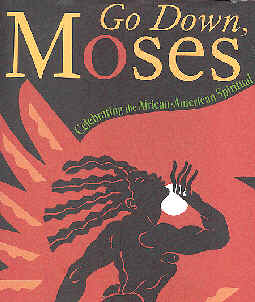
Go Down Moses; A Celebration of The
African-American Spiritual Named
after one of the best known Negro Spirituals,
Richard Newman’s Go Down Moses is a
fascinating and an excellent book. It not only
contains striking thematic drawings of related
content, but also short, fast, easy to read
meanings of the Negro Spirituals in it. The
reader- friendly statement about each
spiritual contains rich, interesting bits
of history related to the song, adding to the
depth of an already significant contribution.
The book is published by Clarkson/Potter
Publishers, New York, 1998.
Bay Area’s Support for Negro
Spirituals Concert Overwhelming
Like in the olden days, when giving support to
friends and neighbors was a way of life, the Bay
Area generously lent its collective hand to Friends
of Negro Spirituals in its promotion of the
San Francisco Moses Hogan chorale concert. The
support enabled the organization to not only sell
its tickets on schedule, but also to generate
demands for tickets that were not available; the
concert sold out almost two month before the date
of the event.
Friends of Negro Spirituals is grateful
to the churches, businesses, organizations,
individuals, choir directors, pastors, radio
personalities, friends, and regular foot soldiers
who amplified its voice, energy, visibility, and
credibility many times over. It thanks Rochelle
Metcalfe, “I heard That,” Sun
Reporter; Sheila Robinson, Gospel program,
radio station KISS, 98.1, Sundays, 5:30 - 9 AM;
Emitt Powell, Gospel program, radio station KPOO,
89.5 FM, Wednesdays/ Fridays, 6 – 9 AM and
Sundays, 6 A.M-12 Noon; E. Powell, Gospel
program, radio station, KPFA, 94.1, Saturdays, 6
– 9 AM; Johnny Otis, “The Johnny Otis
Show,” radio station KPFA, 94.1, Saturdays,
9 AM – 12 Noon; the Print Shop, 2629 San
Pablo Avenue, Oakland, CA; “The Black
Business Listings”; Alex Pritcher,
President, San Francisco NAACP chapter; Leonard
Gordon, Chair, Bay Area Kitchen Cabinet and
Director, Ella Hill Hutch Center; Cassie Cooke,
Ella Hill Hutch Community; Dorothy Cook, Choir
director; Richard Heron, The Gospel Academy, Vera
Brown, Bay Area Support,
continued on page 5.
|